Training data for the real world.
Real-world sensor data for any system that has to perceive, move or decide in the physical world.
The problem
AI is moving into the physical world. Its data is not ready.
Scarce
Unlike text and images, real-world sensor and action data does not exist at internet scale. It has to be collected on real hardware, in real places.
Hard to verify
A 10 millisecond timing offset or a noisy label is invisible in a demo and expensive in deployment. Most buyers cannot audit how their data was made.
Hard to handle
Defense, healthcare and other controlled programs cannot route sensitive collections through generic crowd pipelines. Handling has to be designed in.
The gap
There is no internet for the physical world.
hours of robot manipulation data in the world, estimated
hours of internet video available to train on
Source: Bessemer Venture Partners, Robotics and Physical AI (estimate).
The shift
Training data became a multi-billion dollar business.
Bases differ: recognized vs annualized, gross vs net. Estimates, not audited, and not directly comparable. USD billions.
Market
The market is already bigger than the reports say.
Analyst estimate, 2026
Six research firms size AI training datasets in this range, growing roughly 16% to 23% a year.
Four vendors' annualized revenue
Scale AI, Surge AI, Mercor and Handshake alone, on gross, estimated figures. Net revenue is lower.
Reported per frontier lab, per year
Widely repeated figure for human data spend at leading labs. It traces to a few sources, so treat as indicative.
Sources: Research and Markets and five other firms; Sacra; Forbes; TIME via micro1; Labelbox. See Sources.
Market
Analysts expect 20%+ annual growth.
Scopes differ and should not be added together. Labeling services exclude raw data collection and synthetic data. USD billions.
Where demand is moving
Demand is moving to real-world data.
Rising
- Egocentric and robotics demonstration data
- Expert judgment in professional domains
- Wet-lab and experimental science data
- RL environments
Cooling
- Generalist annotation and microtasks
- Static math and verifiable coding tasks
- Commodity labeling priced on volume
Classification of lab data listings and reported deals, covering Jun 2023 to Oct 2026.Source: aitraining.jobs, What AI Labs Are Buying.
Capital is following
Investors are paying up for data.
| Company | What it does | Reported valuation | Basis |
|---|---|---|---|
| Scale AI | Data labeling and evaluation | ~$29B | Implied by Meta's $14.3B purchase of 49%, Jun 2025 |
| Surge AI | Expert human data | ~$24B | Forbes estimate, Sep 2025. No outside capital raised |
| Mercor | Expert data marketplace | $10B | $350M Series C, Oct 2025. Reported talks at $20B |
| Physical Intelligence | Robot foundation models | ~$20B | Reported talks, Oct 2026, to raise $1B or more |
| Mecka AI | Human motion data for robots | ~$500M | Reported Sequoia-led round, Sep 2026, three months after a $60M round |
Valuations are reported or estimated, not audited, and several are talks rather than closed rounds. Shown for context, not as comparables for Cato Labs.
Demand pull
Every robot that ships needs data to learn from.
Humanoid shipments forecast for 2035
Goldman Sachs, Sep 2026, up from a previous forecast of about 1.4 million.
Forecast for 2030
Goldman Sachs. Its earlier 2030 forecast was 256,000, so the estimate has more than tripled.
China humanoid shipments, 2026
Morgan Stanley, Jun 2026, raised from 14,000 at the start of the year.
Sources: Goldman Sachs and Morgan Stanley forecasts, as reported by 24/7 Wall St., Humanoid Guide and SCMP. See Sources.
Sizing
A small share of this market is a large business.
1% of the 2030 market
1% of the $8.45B AI training dataset market that Research and Markets forecasts for 2030.
3% of the 2030 market
Arithmetic on the same forecast. An illustration of scale, not a revenue forecast.
5% of the 2030 market
The physical-world segment is forecast to grow faster than the whole, at about 24.5% a year.
Sources: Research and Markets (21.6% CAGR, $8.45B in 2030); Emergen Research (24.5% CAGR, robot training data).
Why the gap exists
Incumbents were built for screens, not sensors.
Built for text
Leading vendors scaled on text, code and expert judgment: people at laptops. Physical data needs hardware, sites and safety.
Cannot be bought or scraped
Robot and sensor data has to be created for each task and environment. There is no corpus to license.
Capture competes on volume
Many capture vendors sell hours. Rates are falling, and volume alone is a weak moat.
Controlled domains are underserved
Defense, healthcare and critical infrastructure cannot use open crowd pipelines. Synthetic data does not fully replace real data.
How we are different
The verified real-world data layer.
Our view of the landscape, by category. Illustrative positioning, not a measurement.
The solution
One accountable process, from capture to benchmark.
Capture
Synchronized, calibrated multi-sensor recording on your hardware or ours.
Annotate
Labels against a versioned schema, reviewed and adjudicated.
Evaluate
Held-out benchmarks built to your deployment conditions.
Deliver
Versioned releases in the formats your pipeline already reads.
The product
What the data looks like.
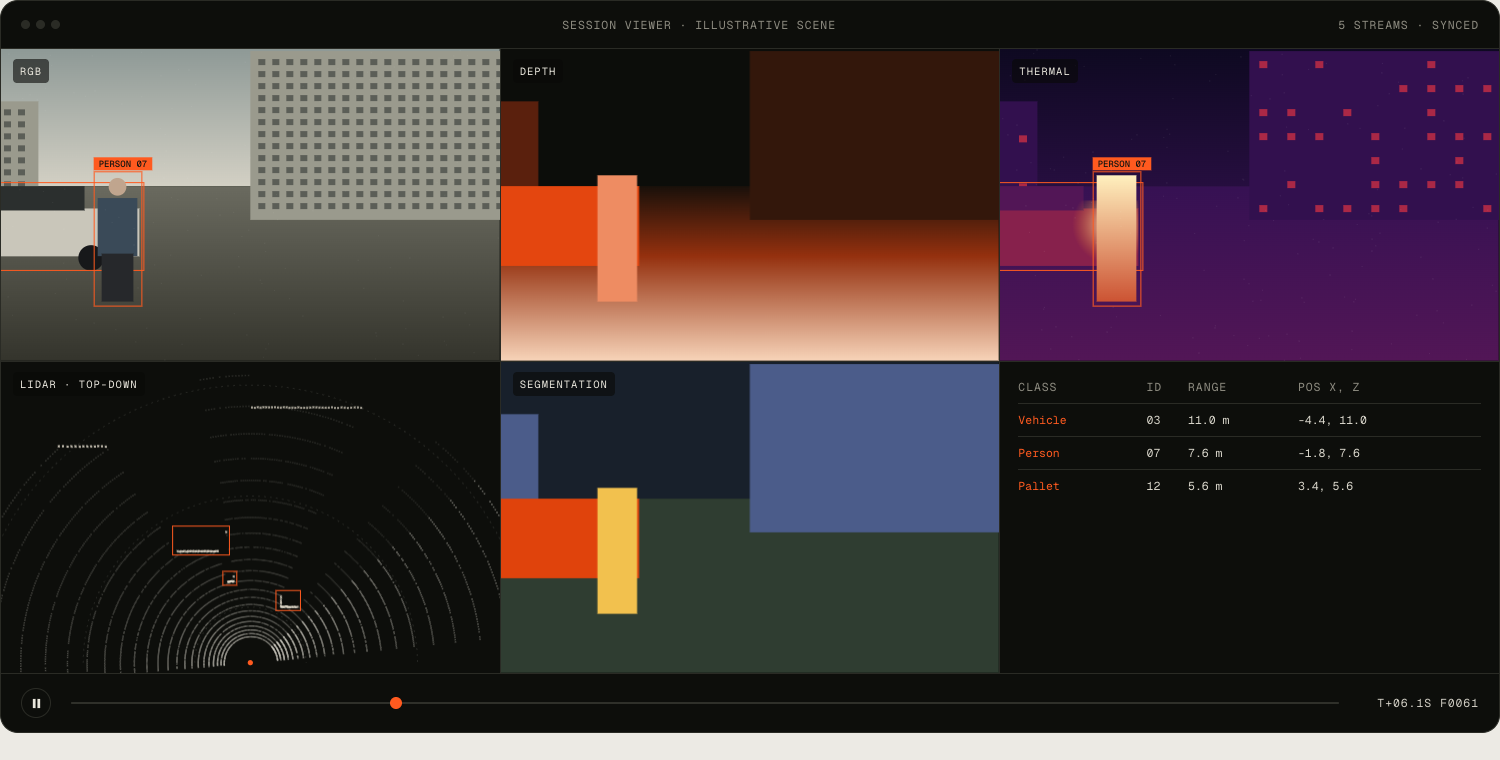
How it works
From a spec to a dataset you can train on.
Scope
Task, sensors, environments, schema and acceptance criteria agreed first.
Collect
Field capture against a written plan, with every session logged.
Annotate
Labeling against guidelines that are versioned and shared.
Verify
Multi-pass review and expert adjudication. QA ships with the data.
Deliver
Versioned releases with a changelog for every update.
Where it is used
Six domains, one standard.
Robotics
Manipulation, navigation and humanoid demonstrations.
Autonomy and mobility
LiDAR and camera data for ground, aerial and maritime vehicles.
Defense and security
Perception in degraded, contested conditions.
Industrial and infrastructure
Inspection of plants, pipelines, grids and sites.
Healthcare and life sciences
Device and procedure capture where consent and compliance allow.
Geospatial and environment
Aerial and satellite imagery, mapping and change detection.
of data labeling revenue comes from automotive and mobility, the largest vertical. Healthcare is the fastest growing, at 24.6% a year. Video, including LiDAR work, grows 31% a year.Source: Mordor Intelligence, AI Data Labeling Market.
Business model
Paid pilots that grow into recurring programs.
Pilot
A fixed-fee, scoped dataset with written acceptance criteria. Low risk for the buyer, and our proof of quality.
Program
Recurring collection and annotation against an evolving spec, on annual or multi-quarter contracts.
Evaluation
Versioned, held-out benchmarks sold as a subscription, so customers can measure progress release to release.
Controlled delivery
Premium scoping for defense, healthcare and infrastructure work that needs special handling.
Go to market
Land with a pilot, win on evidence, expand by domain.
Target
Robotics, autonomy and defense teams already buying data and short of verified physical-world data.
Land
A paid pilot against a written spec, sold founder-to-buyer.
Prove
A held-out evaluation that shows the data improves the customer's model.
Expand
Move from a pilot to a recurring program, then add sensors and sites.
Cross-sell
Carry the same process into adjacent domains, from industrial to healthcare.
Team
Founders who sell, source and hold the line on evidence.
Garrett Martel
- Investment work in venture capital and private equity at Fidelity
- Joined Corgi on the go-to-market team
Oz Harkavi
- Served in the Israel Defense Forces
- Worked at Corgi
in revenue sourced together in six months at Corgi.Why it matters: this business is won by sourcing buyers and running a tight pilot, and defense buyers want to see handling taken seriously.
What sets us apart
Built on standards, not promises.
Synchronized by design
Hardware triggering or a shared clock, with both sensor and host timestamps logged.
Failures are kept
Failed attempts are labeled and retained, so policies learn recovery.
Every label has an owner
Versioned guidelines, independent review and documented adjudication.
Handling comes first
Controlled and restricted requirements are scoped before collection begins.
Landscape
Funded players cluster on raw capture.
| Category | Examples and disclosed funding | Strength | Where Cato fits |
|---|---|---|---|
| Annotation platforms | Encord ($110M), Scale AI | Tooling and scale for labeling | Real-world capture and evaluation in one process |
| Teleoperation and capture vendors | Tacta ($75M), XDOF ($70M), Mecka (~$68M), Config ($35M), Micro1 ($35M) | Demonstrations collected at volume | Provenance, review and controlled handling as standard |
| Simulation and synthetic data | Lightwheel, Applied Intuition, DiffuseDrive | Generating scenarios cheaply | Real captures to validate how well simulation transfers |
Disclosed funding as of Aug 2026, per Teahose and company announcements. Named for context only, not a claim about any company's full offering.
Risks
What could go wrong, and what we do about it.
| Risk | Why it matters | How we respond |
|---|---|---|
| Labs build it in-house | The largest buyers can hire their own collectors. | Be the verified outside layer: provenance, review and evaluation that internal teams rarely staff. |
| Price compression | Capture vendors compete on hours, and rates are falling. | Sell accepted, evaluated datasets and subscriptions, not raw hours. |
| Simulation replaces real data | Synthetic data keeps improving. | Sell the real captures that validate simulation. The two are complements. |
| Operations at scale | Field collection is labor-heavy and hard to standardize. | Written protocols, a logged chain of custody and staged growth by domain. |
Our assessment. Market risks are drawn from the competitive landscape on the previous slides.
Use of funds
What this round pays for.
Collection and annotation
Capture capacity, operator training and review teams, so pilots turn around quickly and to a consistent standard.
Evaluation and tooling
The pipeline that versions datasets, scores them against held-out sets and ships quality results with every release.
Security and go-to-market
Controlled-handling practices that unlock defense and healthcare buyers, and a sales motion built on paid pilots.
Sources, 1 of 2
Where the numbers come from.
| Vendor revenue: Scale AI, Mercor | Sacra | sacra.com/c/scale-ai, sacra.com/c/mercor |
| Vendor revenue and valuation: Surge AI | Forbes, via Contrary Research | research.contrary.com/company/surge-ai |
| Scale AI valuation and Meta transaction | Teahose | teahose.com/guides/scale-ai-valuation |
| Mercor round and reported talks | ValueAdd VC | valueaddvc.com/blog (Mercor valuation) |
| Demand by data category; Mecka and Snorkel run rates | aitraining.jobs, What AI Labs Are Buying | aitraining.jobs/research/what-ai-labs-are-buying |
| Robot data scarcity (300,000 hours vs ~1B hours) | Bessemer Venture Partners | bvp.com/atlas/bessemer-predicts-robotics-and-physical-ai |
| AI training dataset market, $3.87B (2026) to $8.45B (2030); range $3.4B to $4.6B | Research and Markets; Fortune Business Insights, Grand View, Precedence, Straits, MarketIntelo | researchandmarkets.com/reports/5948794 |
| AI data labeling services; vertical shares and growth | Mordor Intelligence | mordorintelligence.com/industry-reports/ai-data-labeling-market |
Sources, 2 of 2
Where the numbers come from.
| Robot training data, $1.05B (2025) to $9.39B (2035) | Emergen Research, via OpenPR | openpr.com/news/4667974 |
| Vendor funding; real-world data spend | Teahose, Robotics Training Data guide (Aug 2026) | teahose.com/guides/robotics-training-data |
| Mecka AI round near $500M | TechCrunch, 11 Sep 2026 | techcrunch.com/2026/09/11/mecka-ai-nears-500m-valuation |
| Physical Intelligence talks near $20B | Bloomberg, 27 Oct 2026 | bloomberg.com/news/articles/2026-10-27 |
| Humanoid shipment forecast, 6.5M by 2035 | Goldman Sachs, via 24/7 Wall St. and Humanoid Guide | humanoid.guide/goldman-raises-2035-humanoid-robot-forecast-to-6-5-million |
| China humanoid shipments, 50,000 in 2026 | Morgan Stanley, via SCMP | scmp.com/tech/article/3358210 |
| Teleoperator pay, $25 to $35 an hour (context for cost drivers) | Developer job postings, via vendor guides | roboticscenter.ai/blog/robot-data-collection-cost |
| Team background and the $1M+ revenue figure | Company information | Provided by the founders |